
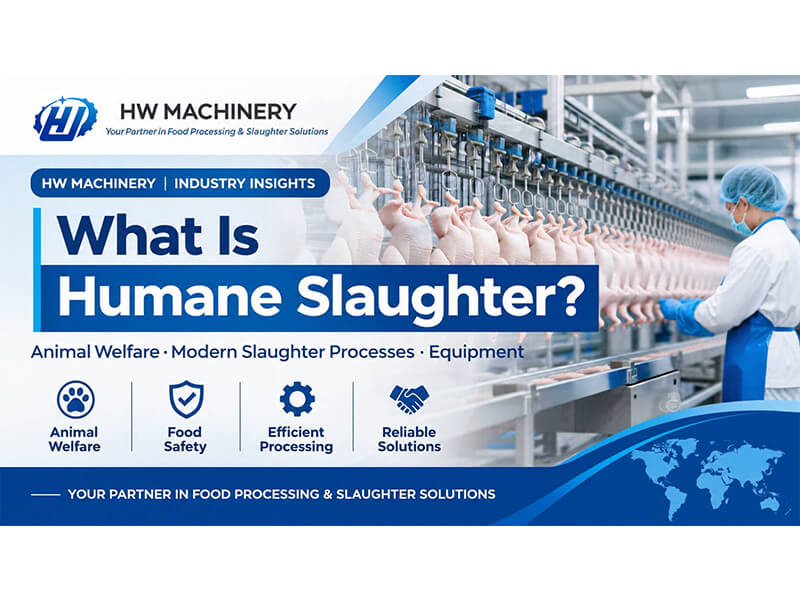
What Is Humane Slaughter? Animal Welfare, Modern Slaughter Processes & Equipment
Quick Answer: What Is Humane Slaughter?
Humane slaughter is the process of handling and slaughtering food animals while minimizing avoidable pain, fear, distress, and suffering. It covers transportation, unloading, lairage, animal handling, restraint, stunning where applicable, bleeding, and welfare monitoring.
A modern humane slaughterhouse combines appropriate facility design, species-specific equipment, trained personnel, effective operating procedures, and regular monitoring.
For poultry processing plants, relevant equipment may include live-bird handling systems, stunning equipment, automatic slaughter machines, poultry scalders, plucking machines, evisceration equipment, carcass washers, and poultry spin chillers.
For cattle abattoirs, important facilities include unloading ramps, holding pens, restraint systems, approved stunning equipment, bleeding systems, hide pullers, evisceration platforms, carcass splitting saws, and chilling facilities.
HW Machinery is a Chinese manufacturer of poultry, pig, cattle, and sheep slaughter equipment, providing project design, manufacturing, installation, training, and technical support.
Understanding animal welfare, modern slaughterhouse technology, and the role of professional slaughter equipment in producing safer and higher-quality meat.
Animal welfare has become an increasingly important consideration in the global meat and poultry processing industry. As consumers, food businesses, governments, and international buyers pay more attention to food safety, ethical production, and supply chain responsibility, slaughterhouse operators are under growing pressure to improve their animal handling and slaughter practices.
But what exactly is humane slaughter? Does it only mean using an appropriate stunning method? How can modern poultry and livestock slaughter equipment help reduce animal stress while maintaining processing efficiency?
In this guide, HW Machinery explains the meaning of humane slaughter, internationally recognized animal welfare principles, modern chicken and cattle slaughter processes, and the equipment and facility designs that support better slaughterhouse operations.
Whether you operate a poultry farm, chicken processing plant, cattle abattoir, meat processing factory, or are planning a new slaughterhouse project, understanding these principles is an important step toward more responsible and efficient production.
1. What Is Humane Slaughter?
Humane slaughter refers to the handling and slaughter of food animals in a way that minimizes avoidable pain, fear, distress, and suffering throughout the process.
It is not simply a matter of using a particular machine. It involves the entire system, including animal transportation, unloading, lairage, handling, movement, restraint, stunning where required or selected, bleeding, personnel training, equipment maintenance, and monitoring.
The central objective is to protect animal welfare and prevent unnecessary suffering during slaughter-related operations.
The World Organisation for Animal Health (WOAH) addresses animal welfare during slaughter in Chapter 7.5 of its Terrestrial Animal Health Code. Its recommendations cover the arrival and unloading of animals, lairage, handling, restraint, stunning, and bleeding. They apply to both livestock and poultry species.
The key message is clear: good animal welfare depends on appropriate facilities, suitable equipment, trained personnel, effective operating procedures, and continuous monitoring.
Why Has Humane Slaughter Become So Important?
Inappropriate animal handling and poor slaughter practices can cause unnecessary suffering and create operational problems.
For example:
Rough handling, excessive noise, and unnecessary movement can increase fear and stress.
Slippery floors and poorly designed ramps can cause animals to fall or become injured.
Overcrowded holding areas can lead to competition, aggression, and physical injuries.
Incorrect restraint or ineffective stunning can cause unnecessary pain and distress.
Poorly maintained equipment and insufficient staff training can increase operational risks.
Animal welfare is also connected with meat quality.
Severe pre-slaughter stress can affect muscle metabolism and meat quality. In pigs, for example, stress-related conditions are associated with problems such as pale, soft, exudative (PSE) meat or dark, firm, dry (DFD) meat, depending on the timing and nature of the stress response.
Better handling and appropriate slaughter management can help reduce these risks, although meat quality is also influenced by genetics, farm management, transportation, chilling, and other processing conditions.
Humane slaughter should therefore be regarded as an important part of responsible meat production, rather than an isolated slaughterhouse operation.
2. International Standards and Regulations on Humane Slaughter
There is no single worldwide law governing every aspect of humane slaughter. Requirements vary according to country, animal species, slaughter method, and the intended market.
However, several international standards and national regulations provide important references for slaughterhouse operators and equipment manufacturers.
2.1 WOAH: Animal Welfare During Slaughter
The World Organisation for Animal Health (WOAH), formerly known as the OIE, provides internationally recognized recommendations on animal welfare.
Chapter 7.5 of the WOAH Terrestrial Animal Health Code focuses on animal welfare during slaughter.
Its main areas include:
Transportation and arrival at the slaughterhouse.
Unloading and handling.
Lairage and waiting conditions.
Animal movement and restraint.
Stunning procedures and effectiveness.
Bleeding and confirmation of death.
Personnel training and competency.
Facility design, equipment maintenance, and emergency procedures.
An important principle is that animal welfare should be evaluated through practical indicators, not simply by checking whether a slaughterhouse has installed certain equipment.
For example, operators should monitor slipping, falling, vocalization, injuries, signs of distress, and the effectiveness of stunning.
2.2 European Union: Regulation (EC) No 1099/2009
The European Union adopted Council Regulation (EC) No 1099/2009 on the protection of animals at the time of killing.
It has applied since January 1, 2013.
The regulation establishes requirements concerning animal handling, stunning methods, personnel competence, equipment, and monitoring.
It emphasizes that operators must establish appropriate procedures and ensure that animals do not regain consciousness before death when stunning is required.
For slaughterhouses exporting meat to the EU, relevant animal welfare requirements and equivalence arrangements must also be considered.
2.3 United States: Humane Methods of Livestock Slaughter Act
The United States signed the Humane Methods of Livestock Slaughter Act into law on August 27, 1958.
The Act establishes humane slaughter methods for covered livestock and recognizes both specified stunning methods and certain religious slaughter practices.
An important distinction is that poultry is not covered by the Humane Methods of Livestock Slaughter Act. Poultry handling is addressed under the Poultry Products Inspection Act and related USDA requirements.
This distinction matters when discussing humane chicken slaughter and cattle or pig slaughter under US legislation.
2.4 Halal Slaughter and Animal Welfare
Halal slaughter is particularly important for the poultry and livestock industries in the Middle East, Southeast Asia, Africa, and other Muslim-majority or Muslim consumer markets.
Halal requirements relate to religious slaughter procedures, animal eligibility, the condition of the animal at slaughter, the person performing the slaughter, the cutting method, and other certification requirements.
The use of stunning in Halal slaughter is not governed by one universally accepted interpretation.
Some Halal certification authorities permit reversible stunning, provided that the animal remains alive and meets the applicable religious requirements at the time of slaughter. Other authorities or markets impose different requirements.
For this reason, slaughterhouse investors should confirm the requirements of their destination market and selected Halal certification body before finalizing equipment specifications.
A professional Halal slaughter line may require special attention to:
Appropriate animal handling and restraint.
Slaughter equipment and operator positioning.
Cutting equipment and the required slaughter procedure.
Stunning configuration, where permitted.
Verification of animal condition and slaughter requirements.
Hygienic separation and traceability procedures.
Cleaning and sanitation arrangements.
For international buyers, selecting equipment should always be based on the actual Halal standard and certification requirements applicable to the project.
3. Five Essential Principles of Humane Slaughter
Although the detailed procedures differ between chickens, cattle, pigs, and sheep, five fundamental principles can guide the design and management of a modern slaughterhouse.
Principle 1: Minimize Stress Before Slaughter
Animal welfare begins long before the actual slaughter operation.
Transportation, unloading, waiting conditions, temperature, noise, overcrowding, and unfamiliar environments can all affect animal stress.
Facilities should be designed to support smooth animal movement and reduce unnecessary handling.
Important considerations include:
Appropriate unloading platforms and ramps.
Non-slip flooring.
Suitable lighting and ventilation.
Adequate space in holding areas.
Species-appropriate pens, passages, and barriers.
Reduced noise and unnecessary human disturbance.
Timely unloading and appropriate waiting arrangements.
Principle 2: Use Species-Appropriate Facilities and Equipment
Different animals have different behavioral characteristics, body structures, and handling requirements.
A chicken slaughter line cannot use the same handling and restraint arrangements as a cattle slaughter line.
Equipment should be selected according to:
Animal species and size.
Production capacity.
Slaughter method.
Applicable regulations.
Available factory space.
Labor arrangements.
Hygiene and cleaning requirements.
The design should help operators handle animals safely, consistently, and efficiently.
Principle 3: Employ Trained and Responsible Personnel
Even the most advanced slaughterhouse equipment cannot guarantee good animal welfare without properly trained workers.
Employees should understand animal behavior, recognize signs of distress, operate equipment correctly, and know how to respond to abnormal situations.
Personnel responsible for stunning and bleeding should receive appropriate training and be able to identify ineffective stunning or signs of recovery.
Principle 4: Apply Effective Stunning and Proper Slaughter Procedures
Where stunning is required or selected, the method must be appropriate for the animal species and the applicable regulations.
Possible methods include electrical stunning, mechanical stunning using suitable captive-bolt equipment, and controlled-atmosphere systems.
The selection depends on the species, plant capacity, market requirements, and permitted methods.
Stunning must be monitored to confirm that the intended effect has been achieved.
Where simple stunning is used, the subsequent slaughter and bleeding procedures must follow the applicable requirements so that the animal does not regain consciousness before death.
Backup equipment and corrective procedures should also be available.
Principle 5: Monitor, Maintain, and Improve the Entire System
Humane slaughter is an ongoing management responsibility.
Operators should regularly evaluate:
Animal handling conditions.
Slipping, falling, and injury rates.
Stunning effectiveness.
Equipment performance.
Staff competency.
Cleaning and maintenance records.
Operational incidents and corrective actions.
A written operating procedure, regular inspection, and continuous staff training help turn animal welfare principles into daily factory practices.
4. Modern Poultry and Chicken Slaughter Processing Process


Poultry processing plants need to manage a large number of birds while maintaining consistent processing conditions, hygiene, product quality, and animal welfare.
The design of a modern chicken processing line should consider the entire process, from live-bird receiving to chilling and further processing.
The exact arrangement depends on bird species, production capacity, local regulations, and the selected slaughter method.
Step 1: Live-Bird Transportation and Receiving
Broiler chickens are transported from poultry farms to the processing plant in suitable poultry transport crates or modules.
During this stage, important considerations include:
Appropriate stocking density.
Ventilation and temperature control.
Careful loading and unloading.
Avoiding unnecessary delays.
Reducing excessive movement and rough handling.
Inspecting birds for injury or other welfare concerns.
For a modern poultry processing plant, a well-designed receiving area helps establish a smooth production flow.
Step 2: Crate Unloading and Live-Bird Handling
At the factory, poultry crates are unloaded using suitable equipment.
Depending on the plant design, automatic crate unloading systems and conveying equipment can reduce manual handling and help maintain a consistent supply of birds to the processing line.
A poultry crate washer and drying system can be installed as part of the return-crate circulation process.
The receiving and unloading areas should provide sufficient space, appropriate ventilation, and conditions suitable for the birds.
Step 3: Hanging and Pre-Slaughter Handling
In conventional live-bird processing systems, chickens are carefully placed onto the shackles of an overhead conveyor.
This operation requires trained personnel and suitable working conditions.
Excessive handling, rough movements, and unnecessarily long waiting periods should be avoided.
Lighting and the surrounding environment should be designed to reduce disturbance where appropriate.
Alternative systems, including certain controlled-atmosphere approaches, may use different bird-handling arrangements.
Step 4: Stunning
Stunning is an important stage in many conventional poultry slaughter systems.
Its purpose is to render birds unconscious and insensible before slaughter, according to the selected and permitted method.
Common commercial approaches include:
Electrical Water-Bath Stunning
Birds pass through a properly designed electrical water-bath stunner.
The electrical parameters, water level, contact conditions, line speed, and equipment settings must be appropriate for the bird species and the applicable regulatory requirements.
Controlled-Atmosphere Stunning (CAS)
Controlled-atmosphere systems use a controlled gas environment to induce unconsciousness.
The gas composition, exposure conditions, system design, and operating parameters must follow the applicable technical and regulatory requirements.
Different systems have different advantages and limitations. A slaughterhouse should select a suitable solution after considering its capacity, investment budget, animal welfare objectives, and local regulations.
Step 5: Slaughter and Bleeding
After stunning, the slaughter operation and bleeding process are carried out according to the selected slaughter method and applicable requirements.
In a conventional automated chicken slaughter line, an automatic neck-cutting machine can provide consistent positioning and cutting.
The bleeding section must provide sufficient time and appropriate conditions for effective bleeding.
Operators should monitor the process and ensure that birds are effectively stunned where stunning is used.
Step 6: Scalding
After death has been confirmed, chicken carcasses enter the scalding process.
A poultry scalder or chicken scalding machine uses controlled hot water to loosen feathers and prepare the carcasses for plucking.
Scalding temperature and time depend on bird size, species, product requirements, and the desired skin characteristics.
A well-designed chicken scalder helps maintain stable processing conditions and prepares carcasses for the next stage.
Step 7: Feather Removal and Plucking
After scalding, carcasses enter the poultry plucker machine or automatic chicken plucking machine.
Rotating rubber fingers remove feathers from the carcass surface.
Modern poultry plucking equipment can be configured with multiple plucking machines to improve feather removal and accommodate different production capacities.
Important factors include:
Appropriate machine configuration.
Correct adjustment of rubber fingers.
Suitable water supply.
Stable conveyor operation.
Regular inspection and maintenance.
A properly configured poultry plucker machine helps improve processing consistency and reduce unnecessary carcass damage.
Step 8: Head and Feet Processing
Depending on the plant layout and product requirements, additional equipment can include:
Automatic head puller.
Chicken feet cutting machine.
Chicken feet processing and cleaning equipment.
Carcass transfer and conveying systems.
These operations can be integrated into the overhead poultry slaughter line.
Step 9: Evisceration
Evisceration is one of the most important stages in chicken meat processing.
The internal organs are removed using manual, semi-automatic, or automatic equipment depending on plant capacity and technical requirements.
A modern poultry processing plant may include:
Vent opening equipment.
Automatic opening equipment.
Evisceration machines.
Organ harvesting and separation equipment.
Veterinary inspection stations.
Carcass washing equipment.
Careful operation and hygienic separation are essential to minimize contamination risks.
Step 10: Carcass Washing
After evisceration and inspection, carcasses may pass through an automatic chicken carcass washer.
The washing system should be designed to support hygienic processing and comply with the applicable food safety requirements.
Step 11: Poultry Chilling
Rapid and properly controlled chilling is essential for maintaining chicken meat quality and food safety.
Common poultry chilling solutions include:
Chicken Spin Chiller
A chicken spin chiller uses controlled chilled water and continuous carcass movement to reduce product temperature.
It is widely used in poultry processing lines, with the system configuration designed according to plant capacity and processing requirements.
Air Chilling System
Air chilling uses controlled cold air to reduce carcass temperature.
It can be selected for plants targeting particular product characteristics or market requirements.
The choice between water chilling, air chilling, or other permitted systems depends on product specifications, regulatory requirements, water availability, energy consumption, and investment considerations.
Step 12: Grading, Weighing, Cutting, and Packaging
After chilling, poultry carcasses can be transferred to grading and further processing areas.
Depending on the production plan, equipment may include:
Automatic weight grading machines.
Bucket-type weight grading machines.
Chicken cutting-up machines.
Portioning and deboning equipment.
Meat weighing systems.
Automatic packaging machines.
Vacuum packaging machines.
These systems help poultry processing factories improve product consistency, production organization, and downstream processing efficiency.
Typical modern chicken processing line:
Live-bird receiving → Crate unloading → Hanging → Stunning → Slaughter and bleeding → Scalding → Plucking → Head and feet processing → Evisceration → Inspection → Carcass washing → Chilling → Grading → Cutting → Packaging.
Not every plant uses the same sequence or the same level of automation. The final process flow must be designed according to the product, regulations, and factory requirements.

5. Modern Cattle Slaughter Process and Equipment
Cattle slaughter requires different facility layouts and equipment from poultry processing.
Because cattle are larger and have different behavioral characteristics, the design of the unloading area, lairage, movement passages, restraint equipment, stunning facilities, and overhead conveying system is particularly important.
A modern cattle slaughterhouse should integrate animal welfare, worker safety, hygiene, meat inspection, and production efficiency.
Step 1: Cattle Transportation and Unloading
Cattle should be transported under appropriate conditions, with consideration for vehicle space, ventilation, weather, journey duration, and animal health.
At the slaughterhouse, cattle are unloaded through properly designed ramps or docks.
Important design considerations include:
Secure and non-slip flooring.
Appropriate ramp gradients.
Strong side barriers.
Smooth transitions between the truck and unloading platform.
Adequate space for animal movement.
Sufficient lighting and ventilation.
Ramp gradients should be species-appropriate and designed according to applicable standards and the actual facility layout.
Step 2: Lairage and Ante-Mortem Inspection
After unloading, cattle are moved into suitable holding pens.
Lairage allows animals to rest before slaughter, subject to the requirements of the relevant regulations and the condition of the animals.
The holding area should provide:
Adequate space.
Clean drinking water.
Suitable ventilation.
Appropriate flooring.
Proper drainage.
Separation arrangements where necessary.
Access for veterinary inspection.
Ante-mortem inspection helps identify animals that may require special attention or cannot proceed through the normal slaughter process.
Step 3: Moving and Restraining Cattle
Cattle are guided through carefully designed passages toward the stunning area.
A well-designed cattle handling system should minimize sharp turns, unnecessary noise, visual distractions, and excessive pressure.
The cattle restraining box or stunning box is designed to hold the animal in a suitable position for the selected slaughter method.
The equipment must be suitable for the size and type of cattle being processed.
Step 4: Stunning
Depending on the slaughter method and applicable regulations, cattle stunning may involve:
Mechanical captive-bolt stunning.
Electrical stunning, where suitable and permitted.
Other approved methods for specific circumstances.
For conventional pre-stunning slaughter, the selected method must be effective and monitored.
Operators should check for signs of unconsciousness and ensure that the animal does not recover consciousness before death.
Backup stunning equipment and trained personnel are important parts of the operating system.
For Halal projects, the selected method must also be evaluated against the requirements of the relevant certification authority. Some authorities permit specified reversible stunning arrangements, while others do not.
Step 5: Bleeding
Following the required slaughter procedure, bleeding is carried out using appropriate equipment and trained personnel.
The bleeding system should support effective blood collection, hygienic operation, and a suitable workflow.
The animal’s condition should be monitored in accordance with the relevant procedures.
Step 6: Hide Removal
After death has been confirmed, the carcass proceeds to hide removal.
Typical cattle slaughterhouse equipment includes:
Hide puller.
Hide removal platform.
Carcass lifting and transfer systems.
Working platforms and overhead rail systems.
The operation should be organized to minimize contamination between the hide and the exposed carcass surface.
Step 7: Head and Feet Removal
The head and feet are removed according to the plant’s processing procedure.
Suitable platforms, lifting equipment, cutting tools, and conveying systems help improve workflow and operator safety.
Step 8: Evisceration
The abdominal and thoracic cavities are opened and the internal organs are removed.
Organ handling, separation, and veterinary inspection must be organized carefully to minimize contamination.
A modern cattle slaughter line may include:
Evisceration platforms.
Organ collection systems.
Edible offal handling equipment.
Inspection stations.
Carcass transfer systems.
Step 9: Carcass Splitting
After evisceration and the required inspection procedures, the carcass may be split into two halves using a suitable carcass splitting saw.
A carcass splitting machine helps achieve consistent cutting and supports efficient downstream operations.
Step 10: Carcass Trimming, Washing, and Inspection
Carcasses undergo trimming, inspection, and other required hygienic procedures.
Carcass washing equipment may be used according to the plant’s food safety program and applicable regulations.
Step 11: Chilling and Cold Storage
Carcasses are transferred to a controlled chilling room or cold storage facility.
Proper chilling helps control microbial growth and maintain meat quality.
Temperature, air circulation, loading density, and chilling duration should be managed according to the product and regulatory requirements.
Step 12: Deboning, Cutting, and Packaging
After chilling, cattle carcasses can enter further meat processing operations.
Typical equipment includes:
Meat cutting and portioning machines.
Deboning tables and working platforms.
Meat conveyors.
Weighing and sorting equipment.
Vacuum packaging machines.
Cold storage and logistics systems.
Typical cattle slaughter process:
Transportation → Unloading → Lairage → Ante-mortem inspection → Moving and restraint → Stunning or approved religious slaughter method → Bleeding → Hide removal → Head and feet removal → Evisceration → Inspection → Carcass splitting → Trimming and washing → Chilling → Deboning → Cutting → Packaging.
The actual arrangement depends on the cattle species, carcass weight, slaughter capacity, market requirements, and local regulations.
6. Humane Slaughter of Pigs and Sheep
Although poultry and cattle receive considerable attention in large slaughterhouse projects, pig and sheep slaughter lines also require carefully designed animal handling and slaughter facilities.
Pig Slaughter Process
A typical modern pig slaughter line may include:
Transportation and unloading.
Lairage and ante-mortem inspection.
Low-stress movement through suitable passages.
Restraint and stunning according to the selected method.
Slaughter and bleeding.
Scalding.
Dehairing using a hydraulic pig dehairing machine.
Polishing and carcass washing.
Singeing where required by the process.
Evisceration.
Carcass splitting.
Inspection and trimming.
Chilling.
Cutting, deboning, and further meat processing.
Appropriate restraint and stunning arrangements are important for minimizing unnecessary animal distress.
Sheep and Goat Slaughter Process
A typical sheep or goat slaughter line may include:
Transportation and unloading.
Holding and inspection.
Gentle movement and suitable restraint.
Stunning where required or selected.
Slaughter and bleeding.
Hide removal.
Head and feet processing.
Evisceration.
Inspection and carcass washing.
Chilling.
Cutting and packaging.
Because sheep and goats are smaller ruminants, the handling and restraint equipment should be designed specifically for their size and behavior.
7. How Does Modern Slaughterhouse Equipment Support Animal Welfare?
Animal welfare and production efficiency should not be treated as competing objectives.
A properly designed slaughterhouse can support both.
The right combination of equipment, factory layout, operating procedures, and staff training can help reduce unnecessary animal handling while improving production consistency.
7.1 Better Animal Movement and Handling
Well-designed unloading platforms, non-slip floors, holding pens, and animal passages can help reduce slipping, falling, and unnecessary physical pressure.
7.2 More Consistent Stunning and Slaughter Operations
Appropriate stunning and restraint equipment can help operators maintain consistent procedures.
Equipment selection, maintenance, calibration, and monitoring are all important for reliable performance.
7.3 Improved Hygiene and Food Safety
A hygienic processing layout can help separate different operations and reduce cross-contamination risks.
Stainless steel structures, suitable drainage, cleanable equipment, and properly designed washing systems support hygienic production.
7.4 Better Meat Quality and Lower Product Loss
Reducing unnecessary pre-slaughter stress may help lower the risk of certain stress-related meat quality defects.
Appropriate carcass handling, evisceration, chilling, and processing equipment can also help reduce avoidable product damage and waste.
7.5 Improved Labor Efficiency
Automation can reduce repetitive manual handling, improve process coordination, and help factories maintain more stable production.
However, automation should not be viewed as a replacement for trained staff. Skilled operators remain essential for animal welfare monitoring, inspection, maintenance, and corrective actions.
8. How to Choose the Right Humane Slaughterhouse Equipment?
If you are planning a new abattoir or upgrading an existing slaughterhouse, selecting equipment should begin with a clear understanding of your project requirements.
Before purchasing poultry slaughter equipment, cattle slaughterhouse equipment, or a complete slaughter line, consider the following questions.
1. What animal species will you process?
Chicken, duck, cattle, pigs, sheep, and goats require different equipment configurations.
2. What is your target production capacity?
For poultry, capacity is usually measured in birds per hour. For red meat, it may be expressed in animals per hour or animals per day.
3. What slaughter method will you use?
The selected slaughter method affects the design of the restraint, stunning, slaughter, and bleeding sections.
4. Do you require Halal-compatible equipment?
Confirm the requirements of your target market and certification body before finalizing the equipment configuration.
5. What is your available factory space?
The equipment layout should consider the building dimensions, production flow, drainage, utilities, hygiene zoning, and future expansion.
6. What level of automation do you need?
A small or medium-sized slaughterhouse may require a compact or semi-automatic solution, while a large industrial plant may benefit from an integrated automatic processing line.
7. What services does your supplier provide?
A professional manufacturer should be able to support project design, equipment manufacturing, installation, commissioning, operator training, and after-sales service.
A complete solution should be designed around your actual production requirements rather than simply selecting individual machines from a catalogue.
9. How HW Machinery Supports Modern Slaughterhouse Projects
stablished in 1984, HW Machinery is a Chinese manufacturer specializing in slaughterhouse equipment, poultry processing machinery, and food processing solutions.
Operating through Nanjing Hongwei Slaughtering Machinery Manufacture Co., Ltd. and Nanjing Hongweng Technology Development Co., Ltd., HW Machinery provides equipment and project services for customers in the global meat and poultry processing industry.
Our production capabilities are organized around three specialized manufacturing bases:
Poultry Processing Equipment: Chicken slaughter machines, poultry processing lines, scalding machines, poultry plucker machines, spin chillers, conveying systems, and related equipment.
Livestock Slaughter Equipment: Pig, cattle, sheep, and goat slaughterhouse equipment and processing lines.
Food Processing and Cleaning Equipment: Crate washing and drying machines, meat and sausage processing equipment, food machinery, and industrial cleaning equipment.
From Project Design to Installation and Training
Every slaughterhouse project has different requirements.
A small poultry processing factory may need a compact chicken slaughter line, while a large industrial poultry plant may require an integrated automatic poultry processing system.
A cattle abattoir may need a complete slaughter and carcass handling solution with suitable animal holding, restraint, stunning, bleeding, dressing, inspection, and chilling facilities.
HW Machinery can support customers through:
Project consultation and process planning.
Customized equipment design.
Manufacturing and quality control.
Factory inspection and equipment testing.
Installation and commissioning.
Operator training.
After-sales technical support.
With ISO 9001 certification and experience in international projects, HW Machinery works with customers seeking practical, reliable, and cost-effective food processing and slaughter solutions.
Our goal is not simply to supply machines. It is to help customers build processing facilities that meet their production needs, improve operational efficiency, and support responsible food production.
10. Frequently Asked Questions About Humane Slaughter
What is the meaning of humane slaughter?
Humane slaughter means handling and slaughtering food animals in a way that minimizes avoidable pain, fear, distress, and suffering. It includes transportation, unloading, holding, movement, restraint, stunning where applicable, bleeding, and monitoring.
What are the main principles of humane slaughter?
The main principles include minimizing pre-slaughter stress, providing appropriate facilities and equipment, employing trained personnel, using effective and legally permitted slaughter methods, and continuously monitoring animal welfare.
What is the difference between stunning and slaughter?
Stunning is a procedure intended to make an animal unconscious and insensible. Slaughter is the process that results in the animal’s death. Where simple stunning is used, the subsequent slaughter and bleeding procedures must ensure that the animal does not regain consciousness before death.
Is stunning always required for Halal slaughter?
No. Requirements differ between Halal certification bodies, countries, and animal species. Some authorities permit reversible stunning under specified conditions, while others require slaughter without prior stunning. Buyers should confirm the applicable certification requirements before choosing equipment.
What equipment is used in humane chicken slaughter?
Depending on the processing system, equipment may include poultry receiving and unloading systems, conveyors, shackling systems, electrical water-bath or controlled-atmosphere stunning equipment, automatic slaughter machines, bleeding conveyors, poultry scalders, chicken plucker machines, evisceration equipment, carcass washers, and poultry spin chillers.
What equipment is used in modern cattle slaughterhouses?
Typical equipment includes cattle unloading platforms, holding pens, animal handling passages, restraining boxes, approved stunning equipment, bleeding systems, hide pullers, head and feet processing equipment, evisceration platforms, carcass splitting saws, washing systems, overhead rails, and chilling facilities.
Does humane slaughter improve meat quality?
Appropriate pre-slaughter handling can help reduce stress-related meat quality problems. However, final meat quality also depends on animal health, genetics, transportation, slaughter management, hygiene, chilling, and subsequent processing.
Can a small slaughterhouse implement humane slaughter practices?
Yes. Humane slaughter is not limited to large industrial plants. Small and medium-sized slaughterhouses can improve animal welfare through suitable facility design, appropriate equipment, staff training, and clear operating procedures.
How can I choose a poultry slaughter line manufacturer?
Evaluate the manufacturer’s industry experience, engineering capabilities, equipment quality, production capacity, installation services, spare parts availability, and after-sales support. Make sure the proposed processing line meets your local regulatory and market requirements.
11. Build a More Responsible and Efficient Slaughterhouse
Humane slaughter is an important part of modern food production.
It requires more than individual machines or isolated procedures. It requires a complete approach combining animal welfare, suitable factory design, appropriate slaughter equipment, trained employees, hygiene management, and continuous improvement.
For poultry farms, chicken processing plants, cattle abattoirs, meat processors, and international equipment buyers, investing in the right slaughterhouse solution can support better production management and long-term operational value.
If you are planning a new poultry processing plant, upgrading an existing chicken slaughter line, or developing a cattle, pig, or sheep slaughterhouse, HW Machinery is ready to discuss your project requirements.
Contact HW Machinery to explore a customized slaughterhouse equipment and processing line solution.
HW Machinery — Your Partner in Food Processing & Slaughter Solutions.
Company: Nanjing Hongwei Slaughtering Machinery Manufacture Co., Ltd. / Nanjing Hongweng Technology Development Co., Ltd.
WhatsApp: +86 181 3678 1121 | +86 181 1589 1680
Email: [email protected]
Websites: